Agent State Persistence Patterns: Beyond Simple Memory to Production-Grade Context Management
Most AI agent implementations treat memory as an afterthought, storing raw conversation history and calling it context. Production systems require sophisticated state persistence patterns that handle multi-session workflows, distributed agent coordination, and regulatory compliance while maintaining sub-100ms retrieval times.

Brandon Lincoln Hendricks
Autonomous AI Agent Architect
What Makes Production Agent State Different
Agent state persistence is the difference between a demo that handles ten conversations and a production system managing ten million. After building state management systems for agents handling everything from financial advisory sessions to multi-week enterprise sales cycles, I've learned that treating state as just stored conversation history is like using a Ferrari as a golf cart.
Production agent state encompasses far more than dialogue. It includes task progress across multiple sessions, decision rationale that must survive legal scrutiny, environmental context that shapes agent behavior, and coordination state between distributed agent teams. When our autonomous sales agents at Hendricks maintain context across dozens of touchpoints over months, they're not just remembering what was said. They're tracking deal velocity, competitive positioning, stakeholder relationships, and strategic objectives.
The Three-Tier State Architecture
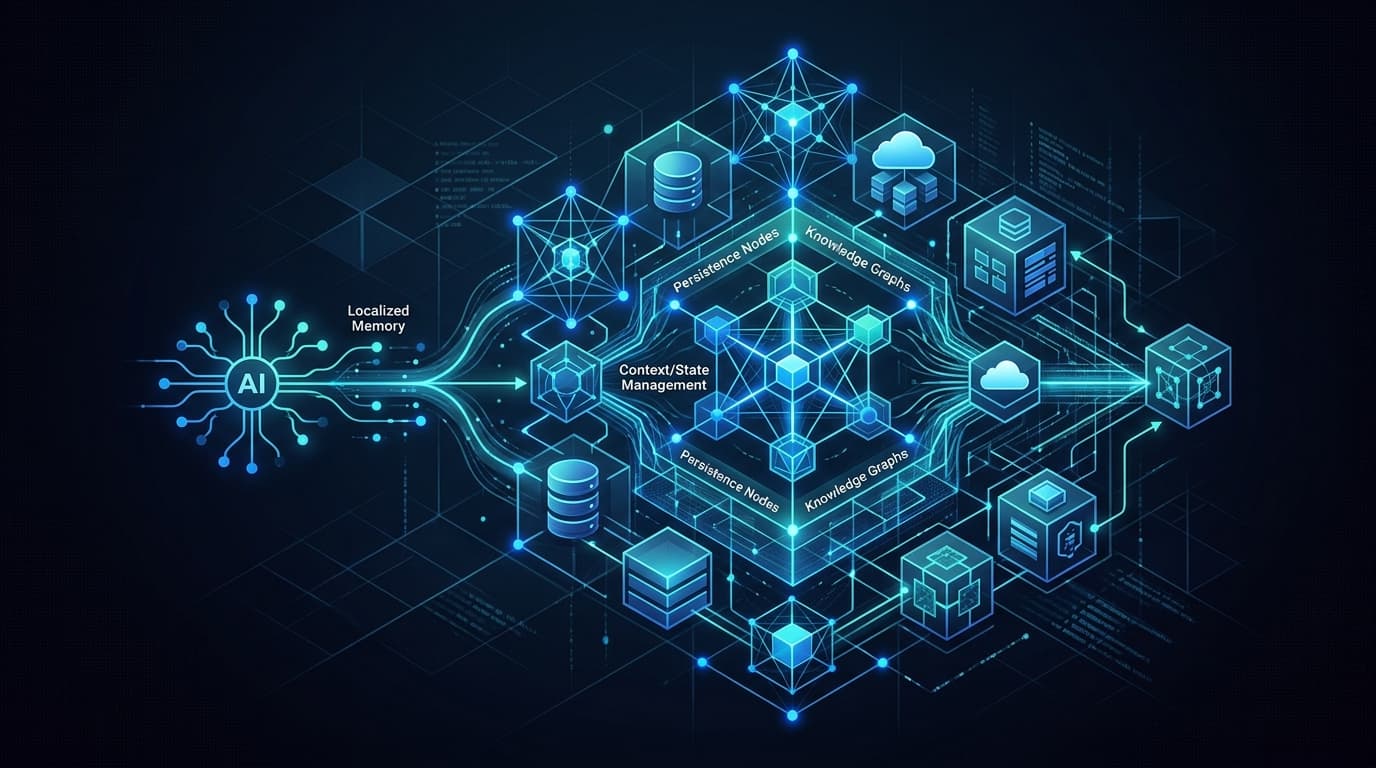
Production state persistence follows a three-tier pattern I've refined across multiple implementations. Hot state lives in Memorystore, serving active sessions with sub-20ms latency. This layer maintains the working context for agents actively engaged with users, including conversation vectors, current task state, and decision buffers.
Warm state resides in Firestore, providing millisecond access to recent contexts and enabling complex queries across sessions. When an agent needs to understand a user's interaction patterns over the past week or retrieve similar decision contexts, Firestore's document model and real-time synchronization capabilities prove invaluable.
Cold state archives to BigQuery, creating a queryable history that powers analytics, compliance reporting, and machine learning pipelines. Every state transition, every decision, every context switch gets captured as structured events that can be analyzed at scale.
How Does Agent State Synchronization Work Across Distributed Systems?
Distributed agent coordination requires sophisticated state synchronization patterns. I implement this through a combination of Pub/Sub for real-time state propagation and BigQuery as the eventual consistency layer. Each agent maintains its own state partition in Firestore while subscribing to relevant state changes from other agents.
The synchronization protocol uses vector clocks to handle concurrent updates and conflict resolution. When multiple agents modify shared state simultaneously, the system applies deterministic merge strategies based on state type. Financial calculations use last-write-wins with audit trails. Collaborative planning states use operational transformation algorithms similar to those in Google Docs.
State synchronization must handle network partitions gracefully. Agents continue operating with locally cached state during connectivity issues, queuing state mutations for later synchronization. The system maintains causal consistency, ensuring that dependent state changes propagate in order even when synchronized asynchronously.
Context Retrieval Patterns for Sub-100ms Performance
Achieving consistent sub-100ms context retrieval requires careful architecture. Raw database queries won't cut it when agents need to access complex state aggregations across millions of records. The solution combines strategic denormalization, intelligent caching, and query optimization.
I structure agent state using a hierarchical model where frequently accessed context summaries are denormalized into parent documents. An agent retrieving user context gets core information from a single Firestore document rather than joining across multiple collections. Detailed state remains normalized in child collections, accessed only when needed.
The caching layer uses Memorystore with intelligent TTLs based on access patterns. Active session state uses 5-minute TTLs with refresh-ahead to prevent cache misses. Historical context uses longer TTLs with lazy loading. The system tracks cache hit rates and automatically adjusts strategies when performance degrades.
Query optimization goes beyond simple indexing. I implement materialized views in BigQuery for complex analytical queries, update them incrementally using Dataflow, and serve results through cached API endpoints. Agents can retrieve insights like 'all similar decision contexts from the past quarter' without scanning millions of records.
What State Types Do Production Agents Actually Persist?
Production agents persist far more than conversation history. Task state captures workflow progress using directed acyclic graphs (DAGs) that survive session boundaries. When a financial advisory agent guides a client through retirement planning, it maintains state for each subtask: risk assessment completion, portfolio analysis progress, recommendation generation status.
Decision state provides audit trails for agent actions. Every significant decision includes the input context, evaluation criteria, alternative options considered, and rationale for the final choice. This proves critical for regulated industries where agents must explain their recommendations to auditors.
Environmental state captures the context in which agents operate. This includes user preferences, organizational policies, regulatory constraints, and temporal factors like market conditions or seasonal patterns. Agents adapt their behavior based on this environmental context without requiring explicit programming.
Coordination state enables multi-agent collaboration. When our sales and support agents work together on an account, they share state about customer interactions, issue history, and strategic objectives. This shared context prevents duplicate efforts and ensures consistent customer experience.
State Versioning and Time Travel Capabilities
Production systems require sophisticated state versioning. Every state mutation creates an immutable event in BigQuery with timestamps, actor identification, and cryptographic signatures. This event-sourced architecture enables powerful capabilities beyond simple audit logging.
Agents can reconstruct historical state by replaying events up to any point in time. This proves invaluable for debugging complex interactions, understanding decision evolution, and meeting compliance requirements. When a financial services client asks why their agent made a specific recommendation six months ago, we can reconstruct the exact context and decision process.
Critical states create named snapshots stored in Cloud Storage. Before major operations like bulk portfolio rebalancing or campaign launches, agents checkpoint their state. If issues arise, they can instantly rollback to known-good configurations without reconstructing from events.
The versioning system supports branching scenarios where agents explore alternative paths without committing changes. An agent might evaluate multiple negotiation strategies in parallel branches, comparing outcomes before selecting the optimal approach. This speculative execution happens without polluting the main state timeline.
Compliance and Data Governance in State Persistence
Regulatory compliance shapes every aspect of state persistence design. Data residency requirements mean state must be stored in specific geographic regions. I implement this through BigQuery datasets and Cloud Storage buckets configured for single-region storage, with Firestore instances deployed to match residency requirements.
PII detection and handling uses Cloud DLP to automatically scan state data for sensitive information. The system can redact, mask, or encrypt sensitive fields based on configurable policies. Credit card numbers get tokenized, social security numbers get masked, and medical information gets encrypted with customer-managed keys.
Retention policies automatically purge expired state while maintaining referential integrity. The challenge lies in removing user data after retention periods while preserving agent learning and analytical insights. I solve this through anonymization pipelines that strip identifying information while retaining behavioral patterns and decision contexts.
Audit trails use cryptographic signatures to ensure tamper-proof records. Every state mutation gets signed with the agent's service account key, creating a chain of custody that proves data integrity. External auditors can verify that historical state hasn't been modified post-facto.
Performance Optimization Strategies
Scaling state persistence to handle millions of concurrent agents requires careful optimization. The primary bottleneck isn't storage capacity but query performance and synchronization overhead. I've developed several patterns that maintain performance as systems scale.
Partitioning strategies distribute state across multiple Firestore collections and BigQuery tables based on agent ID, timestamp, or geographic region. This horizontal scaling ensures that no single partition becomes a bottleneck. Queries route to appropriate partitions based on request parameters.
Batch processing reduces synchronization overhead. Instead of synchronizing every state change immediately, agents batch updates over short windows (typically 100-500ms) and sync in bulk. This dramatically reduces Pub/Sub message volume and Firestore write operations while maintaining near-real-time consistency.
Read replicas handle analytical queries without impacting operational performance. BigQuery materialized views and Firestore collection mirrors serve reporting and analytics workloads. The operational state stores handle only active agent queries, maintaining consistent low latency.
Multi-Agent State Coordination Patterns
Coordinating state across agent teams requires sophisticated distributed systems patterns. I implement a hierarchical state model where team-level state aggregates individual agent states. A sales team lead agent maintains rolled-up state from individual sales agents, providing team-wide visibility without querying each agent directly.
Consensus mechanisms ensure consistency when multiple agents must agree on shared state. For critical decisions like pricing approvals or risk assessments, agents use a simplified Raft protocol implemented on top of Firestore transactions. This provides strong consistency guarantees while remaining performant for small agent groups.
Event choreography coordinates complex multi-agent workflows without tight coupling. Agents publish state change events to Pub/Sub topics. Other agents subscribe to relevant events and react accordingly. This loose coupling allows agent teams to evolve independently while maintaining coordination.
Conflict resolution strategies handle concurrent modifications to shared state. The system uses a combination of operational transformation for collaborative text editing, vector clocks for causal ordering, and domain-specific merge strategies for business logic. Financial calculations might use conservative merge strategies while creative tasks use more permissive approaches.
Migration Patterns for Legacy Systems
Most organizations don't start with sophisticated state management. They evolve from simple conversation logs to production-grade persistence. I've developed migration patterns that enable this transition without disrupting active agents.
The strangler fig pattern gradually replaces legacy state systems. New state writes go to both old and new systems during migration. Reads prefer the new system but fall back to legacy data. Over time, all reads migrate to the new system and legacy writes can be disabled.
State transformation pipelines handle format conversion using Dataflow. Legacy conversation logs get parsed, structured, and enriched with metadata before inserting into the new state stores. Machine learning models can infer missing context from historical patterns.
Backfill strategies populate historical state without overwhelming production systems. I implement rate-limited batch processors that migrate historical data during off-peak hours. Priority queues ensure that frequently accessed historical state migrates first.
Future-Proofing State Architecture
Production state systems must evolve with changing requirements. The patterns I've described provide a foundation, but successful implementations anticipate future needs. Extensible schemas allow adding new state types without migration. Event-sourced architectures enable reprocessing historical data as requirements change.
The shift toward larger context windows in models like Gemini 1.5 Pro changes state persistence requirements. Agents can maintain richer, longer-term context without aggressive summarization. State systems must handle larger individual documents while maintaining query performance.
Multi-modal state becomes increasingly important as agents process documents, images, and audio. State persistence must handle vector embeddings, binary attachments, and cross-modal references while maintaining the same performance guarantees as text-based state.
The architecture patterns I've outlined handle these evolutionary pressures. By separating concerns across tiers, implementing flexible schemas, and maintaining clear abstraction boundaries, production state systems can adapt to new requirements without fundamental restructuring. The key is building for change from day one rather than optimizing for current requirements alone.